What is an off-road go kart?
A plain-English family guide
What Is an Off-Road Go-Kart?
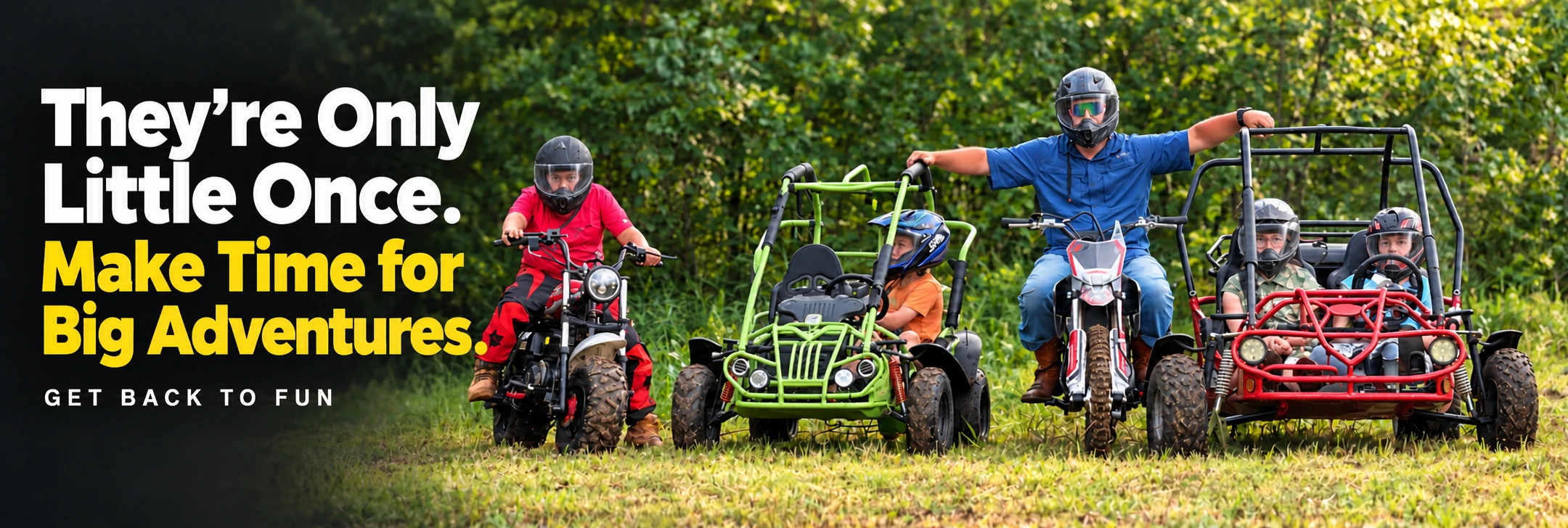
An off-road go-kart is a small recreational powersports machine built to carry one or two riders across grass, dirt, gravel and maintained trails. It combines the simple controls of a go-kart with suspension, treaded tires, ground clearance and protective equipment designed for outdoor family riding.
It is not a pavement racing kart, a street vehicle or a maintenance-free toy. It is a real machine that needs an appropriate riding area, protective gear, adult judgment and routine service.
The short answer
An Off-Road Go-Kart Is Built for Outdoor Recreation
Unlike a low pavement kart, an off-road kart has a stronger recreational chassis, shocks, treaded tires and enough ground clearance to travel across ordinary uneven ground. TrailMaster models use simple accelerator-and-brake controls, automatic clutch or CVT systems and rear-wheel drive.
The goal is not maximum racing speed. The goal is to give children, teens and adults an approachable way to ride around a farm, explore a trail, make laps on a backyard track or enjoy outdoor time together.
What changes when the pavement ends
What Makes a Go-Kart Off-Road?
Suspension
Shocks and springs allow the wheels and chassis to react to ruts, grass, small bumps and changing ground instead of transferring every impact directly to the riders.
Treaded tires
Knobby off-road tread provides grip on dirt, grass and gravel. Tire size and pressure also affect ride quality, steering and traction.
Ground clearance
The frame and drivetrain sit higher than a racing kart, helping the machine cross ordinary trail irregularities without dragging on every rise.
Automatic drive
Depending on the model, a centrifugal clutch or CVT transfers power automatically. The driver concentrates on steering, accelerating and braking instead of operating a manual clutch.
Protective structure
TrailMaster karts use a surrounding cage, restraints and seating designed for the model. These features support safer habits but do not make careless riding harmless.
Family-sized choices
Mini, Mid and full-size platforms let families choose by rider fit, experience, terrain and supervision needs instead of buying one generic size.
GoKartMasters field note
Off-Road Does Not Mean Indestructible
These machines are made for ordinary outdoor riding, not motocross jumps, deep mud, submerged engines or high-speed side-hilling. A puddle, a shallow muddy patch or a small creek crossing may be reasonable when the driver can see the bottom and keep the intake and engine dry. Burying a kart in mud is a different kind of use.
The best owners pay attention to how the kart normally looks, sounds and feels. They slow down for unknown terrain, inspect after a hard impact and stop when something changes.
Similar name, different purpose
Off-Road Go-Kart vs. Racing Kart, Rental Kart and UTV
| Machine | Built For | Typical Construction | Best Setting |
|---|---|---|---|
| Off-road go-kart | Approachable family recreation | Suspension, treaded tires, cage, restraints and automatic drive | Private land and permitted off-road trails |
| Pavement racing kart | Lap times and handling on smooth surfaces | Low chassis, little or no suspension and pavement tires | Closed paved tracks |
| Rental or amusement kart | Short supervised sessions | Heavy bumpers, restricted route and commercial fleet design | Managed amusement tracks |
| UTV or side-by-side | Larger riders, work and more demanding terrain | Larger engine and chassis; many models add four-wheel drive and utility equipment | Property work and wider legal trail systems |
Where Can a Family Ride an Off-Road Go-Kart?
Good places to ride
- Private farms and acreage with permission
- Backyard tracks designed with safe runout space
- Maintained dirt roads on private property
- Open fields after checking for holes and debris
- Wooded paths wide enough for the kart
- Public or campground trails that specifically allow the machine
Places and conditions to avoid
- Public streets and ordinary road traffic
- Ponds, deep water and mud that can submerge the engine
- Drop-offs, steep side slopes and blind hills
- Crowded areas, parked vehicles and unprotected spectators
- Unknown trails without checking width and obstacles
- Any property or trail where motorized karts are prohibited
Permission and local rules matter. Recreational go-karts are not supplied as street-legal vehicles. Public land, trails and campgrounds set their own vehicle rules, so confirm access before loading the trailer.
What an Off-Road Go-Kart Can Handle
Usually a good match
Grass and yards
Check for hidden holes, wire, branches, sprinkler heads and wet slopes before the first lap.
Usually a good match
Dirt and gravel
Allow more stopping distance on loose surfaces and slow down around dust, washboard sections and blind corners.
Use judgment
Hills
Approach straight, keep steady momentum uphill, use the brakes downhill and never travel sideways across a hill without a safe established path.
Use judgment
Mud and water
Cross only shallow, visible conditions. These are not mud machines, and the intake, engine and electrical components should not be submerged.
Choose the model carefully
Rocks and rough trails
Suspension helps, but wheelbase, clearance and tire placement still matter. The full-size 300E XRX is the TrailMaster rough-terrain specialist.
Choose by fit and use
Which TrailMaster Size Fits Your Family?
Mini
Best starting point for a young or completely inexperienced child.
- Compact youth cockpit
- Current XRX models include remote shutoff
- Good for smaller yards and paths
- May disappoint an experienced child quickly
Mid
Our best all-around youth and long-term family platform.
- More room and capability than a Mini
- Full suspension and automatic CVT
- Mid XRX-R adds useful reverse
- No wireless remote shutoff
Full-size 200
Our general recommendation for adults, older children and mixed family use.
- Room for two adults or an adult and child
- Strong choice for farms, trails and hills
- Carbureted and EFI owner choices
- Forward, neutral and reverse
Full-size 300
A specialized liquid-cooled platform, not an automatic upgrade from the 200.
- More complicated and expensive to repair
- Not our preferred hill-climbing kart
- 300E XRX handles rough terrain especially well
- Best for a mechanically capable owner
What ownership really looks like
An Off-Road Go-Kart Is a Powersports Machine, Not a Toy
Assembly
Freight-delivered karts arrive approximately 80 percent assembled. A capable family using ordinary metric tools can complete the remaining assembly and inspection.
Break-in service
The required first service is at five hours. Change the engine oil, inspect the machine and address the adjustments that appear while new parts settle.
Regular maintenance
Plan for service about every 20 riding hours or once a year, whichever comes first. Belts, chains, brakes, fuel and batteries all need attention.
Parts and repairs
Occasional adjustments and repairs are normal. TrailMaster parts continuity and GoKartMasters model support are major reasons we stay with this platform.
Read our honest TrailMaster quality and long-term ownership guide
Basic Family Safety
A cage, harness or remote shutoff cannot replace supervision and good instruction. Before normal riding:
- Use a properly fitted DOT-approved full-face helmet and closed-toed shoes.
- Place one rider in each intended seat and secure every restraint snugly.
- Teach the driver the accelerator, brake, steering and kill switch with the engine off.
- Keep arms and legs inside the cage and teach riders never to catch a tipping kart with their hands.
- Inspect the brake, throttle return, steering, tires, chain and hardware.
- Begin each session with a slow caution lap and check the riding area for new hazards.
- Keep children within an adult's eyesight. When a model has a wireless remote, the supervising adult should keep it available.
Why our answer is different
We Actually Ride the Machines We Explain
GoKartMasters is a small family business with four generations of go-kart and small-engine experience. Our family uses these machines on backyard tracks, trails, camp property and South Dakota dirt roads. We assemble them, stock their parts and help owners diagnose them after the sale.
That is why our guides talk about rider fit, parking brakes, fuel quality, service intervals and the model you may not need. We are helping a family choose something they can enjoy and keep running, not copying a factory brochure.
Watch GoKartMasters AcademyCommon questions
Off-Road Go-Kart FAQs
Is an off-road go-kart the same as a dune buggy?
Can an off-road go-kart drive on pavement?
Are TrailMaster go-karts four-wheel drive?
Can an off-road go-kart climb hills?
Can a TrailMaster go-kart go through mud or water?
Is an off-road go-kart safe for a child?
How fast does an off-road go-kart go?
Does an off-road go-kart require maintenance?
What is the best off-road go-kart for a family?
Ready to Find the Right Family Go-Kart?
Start with rider fit, experience and where your family will actually ride. If you are still uncertain, tell us about your riders and property and we will help you narrow the choices.