TrailMaster 150/200 Idle Adjustment
GoKartMasters adjustment guide
TrailMaster 150/200 Go-Kart Idle Adjustment
Use this guide when a carbureted TrailMaster 150 or 200 idles too high, stalls at idle or becomes difficult to shift because the engine speed will not settle down.
Before turning the carburetor screw, inspect the throttle cable. A cable that is too tight can hold the throttle open and make a correct carburetor adjustment impossible.
Identify the fuel system first
Which Go-Karts Use This Procedure?
This guide is for carbureted TrailMaster full-size go-karts with GY6 engines, including many older and current models:
Carbureted 150 models
TrailMaster 150 XRS, 150 XRX, Blazer 150, Blazer 150X and related carbureted 150-series machines.
Carbureted 200 models
TrailMaster 200 XRS, the discontinued carbureted 200 XRX, Blazer 200X and related carbureted 200-series machines.
Not for EFI models
Do not use this procedure on the 200E XRS, 200E XRX, Blazer 200EX or current 300E models. EFI idle is electronically managed and requires EFI-specific diagnosis.
Not sure which machine you own? Use the TrailMaster model identification guide before adjusting or ordering parts.
Start with what the kart is doing
High Idle, Low Idle or a Cable Problem?
Idle is too high
- Engine races after the throttle is released
- Kart is difficult to shift
- Gears grind or resist engagement
- Engine speed hangs instead of settling
Idle is too low
- Engine starts but dies without throttle
- Kart stalls after warming up
- Engine will not remain running in neutral
- Idle is uneven or repeatedly drops
Throttle cable is involved
- Pedal or carburetor arm does not return fully
- Idle changes when the cable is moved
- Cable has no free movement at rest
- Cable sheath or mounting nuts are loose
Why High Idle Makes a TrailMaster Hard to Shift
The engine, CVT and forward-neutral-reverse system are designed to shift while the engine has settled to a low idle. When idle speed remains too high, rotating drivetrain components continue loading the gears. The shifter may resist movement, grind or refuse to enter forward or reverse.
Do not force the shifter. Come to a complete stop, let the engine return to idle, press the brake and then select the gear. If the engine is idling correctly but the kart still will not shift, the shifter cables may need adjustment.
Safety first
Secure the Kart Before Working Near a Running Engine
- Work outdoors in a well-ventilated area.
- Select neutral and chock the wheels so the kart cannot move.
- Keep riders out of the kart while making the adjustment.
- Keep hands, hair, clothing and tools away from the chain, CVT cover, fan and other moving or hot parts.
- Stop immediately if the throttle fails to return, fuel leaks or the kart attempts to move in neutral.
Step-by-step procedure
How to Adjust the Carburetor Idle
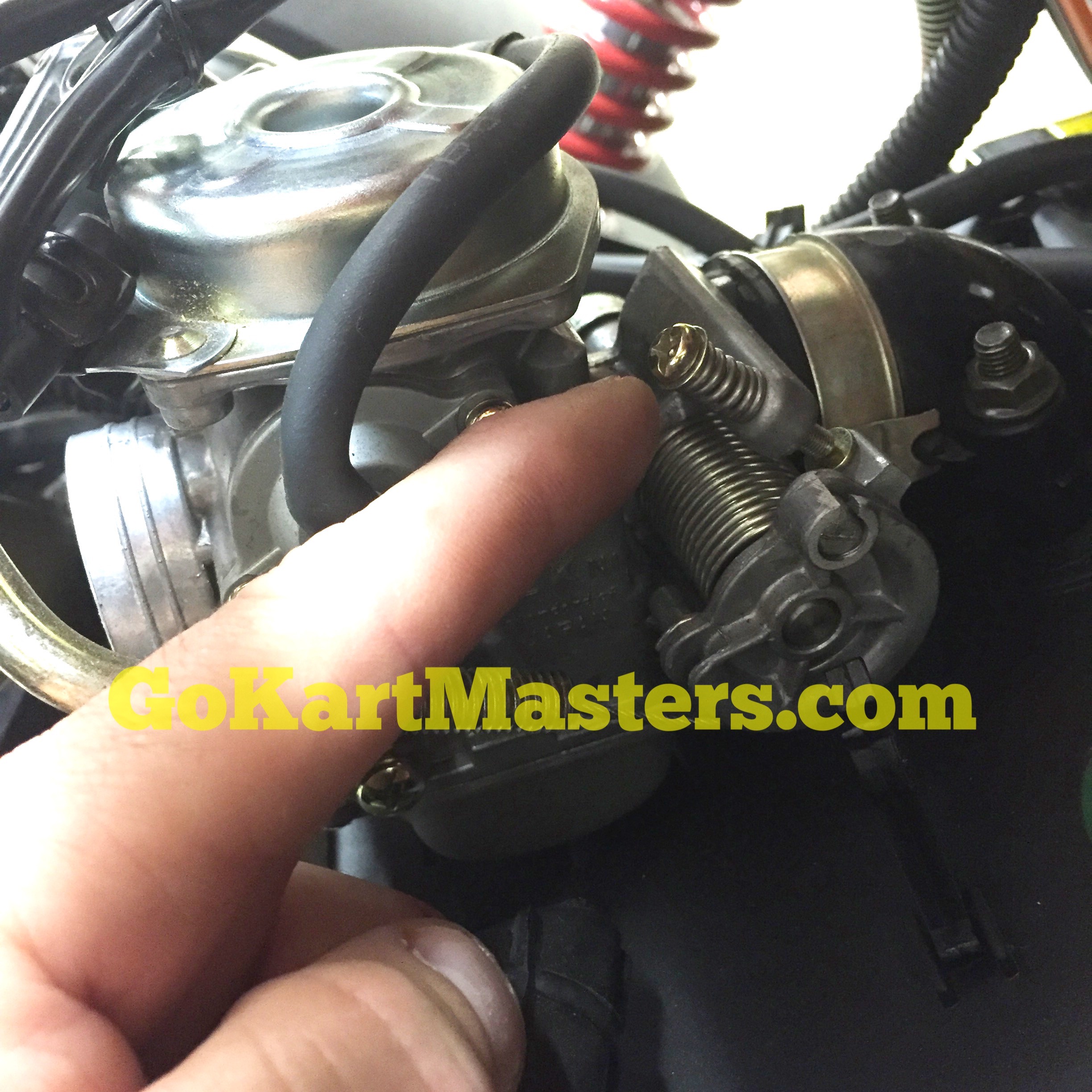
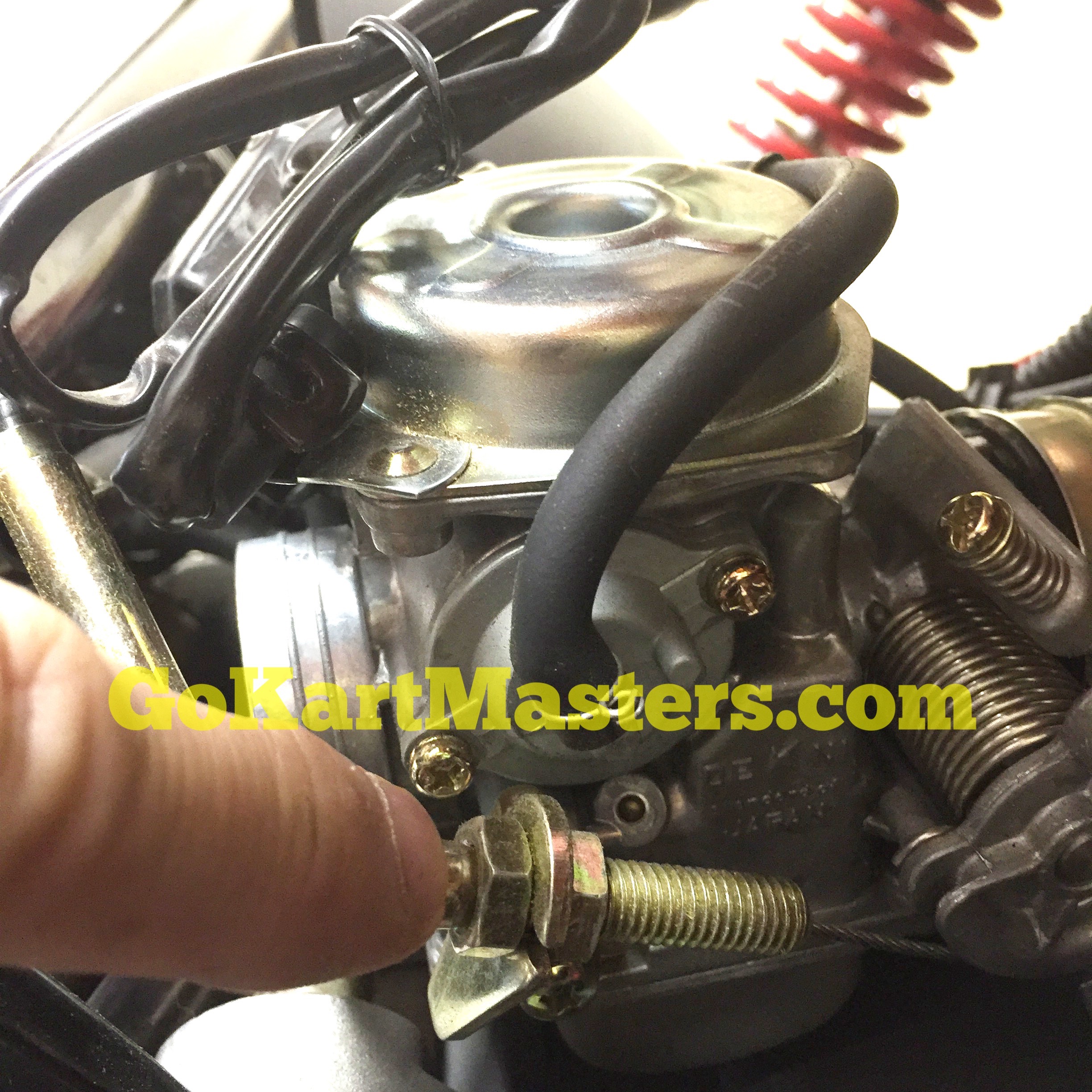
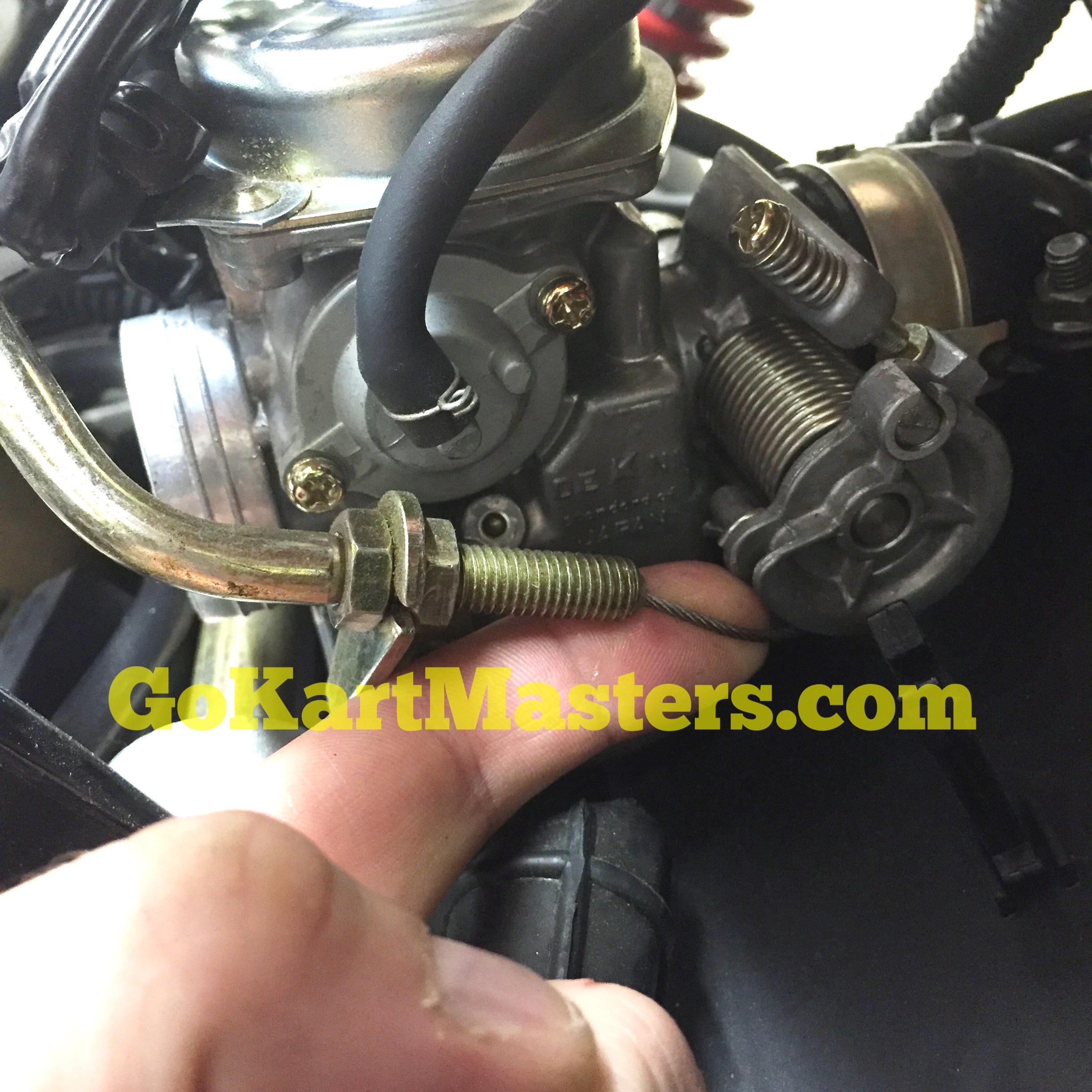
- Confirm the machine is carbureted. EFI models do not use this mechanical idle-adjustment procedure.
- Inspect throttle return with the engine off. Press and release the accelerator. The pedal, cable and carburetor arm must return freely and completely every time.
- Check the throttle-cable mounting nuts. Tighten loose mounting hardware. The cable should have a small amount of free movement at rest. A cable held too tightly can keep the throttle open; excessive slack can allow the cable to leave the cam.
- Start and fully warm the engine. Allow approximately five minutes before making the final idle adjustment. Choke must be completely off once the engine is warm.
- Locate the idle screw. It is normally the gold Phillips-head screw with a spring around it on the passenger side of the carburetor. Do not confuse it with a fuel-mixture screw.
- Turn the screw in small increments. Turn clockwise to raise idle speed. Turn counterclockwise to lower idle speed. Use approximately one-eighth turn at a time and wait for the engine to respond.
- Set the lowest stable idle. The goal is for the warm engine to continue running without throttle while remaining slow enough for the kart to shift cleanly.
- Test the result safely. With the kart stopped and the brake applied, select forward and reverse. Do not force the shifter or continue if the gears grind.
If the screw does not solve it
The Idle Screw Cannot Correct Every Problem
Idle stays too high
- Throttle cable is too tight, kinked or routed incorrectly
- Pedal, cable or throttle arm is binding
- Throttle return spring is damaged or disconnected
- Choke is not fully opening after warm-up
- Intake or vacuum leak is creating a lean, hanging idle
Idle stays too low or stalls
- Stale, dirty or water-contaminated gasoline
- Restricted idle jet or dirty carburetor passage
- Fuel flow, tank vent or vacuum-line problem
- Choke use or cold-start procedure is incorrect
- Spark plug is worn, wet or heavily fouled
Idle is correct but shifting is hard
- Shifter cables need adjustment
- Cable is kinked, bound or damaged
- Driver is shifting before the kart stops
- Throttle is not returning fully before the shift
- Drivetrain diagnosis is needed before forcing the lever
GoKartMasters field notes
Check the Cable Before Blaming the Carburetor
We often find that the carburetor is not the real reason a 150 or 200 idles too high. A throttle cable with no free movement can hold the throttle arm slightly open, and no amount of turning the idle screw will overcome it.
We also see owners force a shifter because the kart is idling too fast. Correct the idle and cable adjustment first. TrailMaster gearboxes are durable, and hard shifting is much more commonly caused by engine speed or cable adjustment than internal gearbox failure.
Watch the related procedures
GoKartMasters Academy Videos
Quick answers
Idle Adjustment FAQs
Which direction lowers the idle?
Turn the spring-loaded idle screw counterclockwise in small increments. Clockwise raises the idle.
Should I adjust the idle while the engine is cold?
No. Start the engine correctly, move the choke fully off and let the engine warm for approximately five minutes before making the final adjustment.
Why does the idle rise when I tighten the throttle cable?
A cable adjusted too tightly can pull the throttle arm away from its idle stop. Leave a small amount of free movement while keeping the cable secure on its cam.
Can this procedure fix an EFI kart?
No. EFI machines use an ECU, throttle body, injector and sensors. Diagnose voltage, connections, fuel pressure and EFI components rather than turning a carburetor idle screw.
Why does my kart still grind after the idle is lowered?
Come to a complete stop and let the engine settle before shifting. If grinding continues at a stable low idle, inspect and adjust the shifter cables before suspecting internal gearbox damage.
Related GoKartMasters Resources
Still Cannot Set a Stable Idle?
If the throttle returns correctly but the warm engine still races, stalls or will not shift cleanly, stop adjusting and document the symptoms. GoKartMasters customers receive priority support from the family and technicians who sell, ride and service these machines.
Send the purchaser name, order number when available, exact model, photos of the carburetor and cable, a description of what changed and the adjustments already attempted. Videos must be emailed.